All News

Verified reporting, real-time dispatches, and in-depth stories from the ViralUG newsroom.

Advertisement
Tinubu to Aspirants: Don’t make promises you cannot fund Politics

Tinubu to Aspirants: Don’t make promises you cannot fund

By Nwafor Sunday Polycarp, Online News Editor President Bola Tinubu has challenged those seeking to lead Nigeria to explain the cost of their campaign promises, how they intend to implement them and whether they can sustain them. Tinubu said every government commitment must be backed by a credible plan and be financially sustainable to avoid passing the burden to Nigerians and future generations.   The President stated this in a post on his X platform on Sunday, stressing that leaders must balance the need to provide immediate relief with the responsibility to protect the future of the country’s children.   “As President, I have a duty to provide relief today without compromising our children’s future.   “Every commitment must be sustainable and backed by a credible plan. That responsibility guides our decisions, including the difficult ones,” he said. Tinubu added that political promises were easy to make when their costs could be deferred, leaving citizens and future generations to bear the consequences.   “Anyone seeking to lead Nigeria should be prepared to explain what their promises will cost, how they will deliver them, and whether they can sustain them. Promises are easy to make when the costs can be postponed, leaving Nigerians and future generations to pay the bill,” he said. The President also referred to the stories of some Nigerians, including Blessing, Ada, Abigail and Kabir, saying their experiences demonstrated the impact of government investments on people’s daily lives.   He also acknowledged a request from Emmanuel, saying it reminded him of the work still required to expand access to essential services. Emmanuel, your request reminds me of the work still ahead. I know many more Nigerians like you are waiting for these services,” Tinubu said.   He stressed the need to continue expanding access to affordable transportation across the country, noting that the Federal Government would work with state governments to achieve the objective.   “Our responsibility is to keep expanding access until affordable transportation becomes a reality for more communities across our country. That is the work we will continue in collaboration with the States,” he added.

Oct 12, 2026 • 34
Fitch revises Nigeria’s outlook to positive, affirms ‘B’ rating Business

Fitch revises Nigeria’s outlook to positive, affirms ‘B’ rating

By Emma Ujah, Abuja Bureau Chief Fitch has revised Nigeria’s Long-Term Issuer Default Ratings outlook from Stable to Positive, citing the success of the sustained economic reforms and rising foreign exchange reserves. The Global rating agency also noted the easing inflationary pressures and improved prospects for economic growth, which the World Bank has projected at 4.3 per cent for this year. The agency also affirmed Nigeria’s rating at “B”. According to the agency, exchange rate flexibility, declining inflation and faster-than-expected accumulation of foreign exchange reserves were major factors behind the improved assessment. Nigeria’s gross external reserves hit $55 billion last month from $32 billion in mid-April 2024. Fitch said the positive outlook reflected its growing confidence that the government would sustain reforms aimed at strengthening Nigeria’s policy framework and improving macroeconomic stability. The formalisation of foreign exchange transactions, portfolio inflows, higher export earnings and remittances by Nigerians in the Diaspora all play roles in the new rating. The projected expansion is expected to be driven largely by non-oil economic activities.The rating agency also noted that Nigeria’s crude oil production had met the Organisation of Petroleum Exporting Countries’ (OPEC) target of 1.5 million barrels per day since May 2026. It added that increased domestic refining capacity was helping to reduce imports of refined petroleum products and the associated demand for foreign exchange. Fitch projected average inflation to be at 15.4 per cent in 2026, less than half its 2024 level. It expressed optimism that ongoing tax reforms would improve non-oil revenue mobilisation and strengthen government finances. The Minister of Finance and Coordinating Minister of the Economy, while reacting to the development, in a statement on Friday said, “A positive outlook signals that the rating could be raised if current trends are sustained.” Mr. Oyedele said the decision was further validation that the administration’s reforms were working and impacting positively on the economy. According to him, “with this action, all three major international rating agencies have taken positive rating actions on Nigeria in 2026.”

Oct 12, 2026 • 9
‘We must stick together’ — Haaland after Man City’s win amid financial charges Sports

‘We must stick together’ — Haaland after Man City’s win amid financial charges

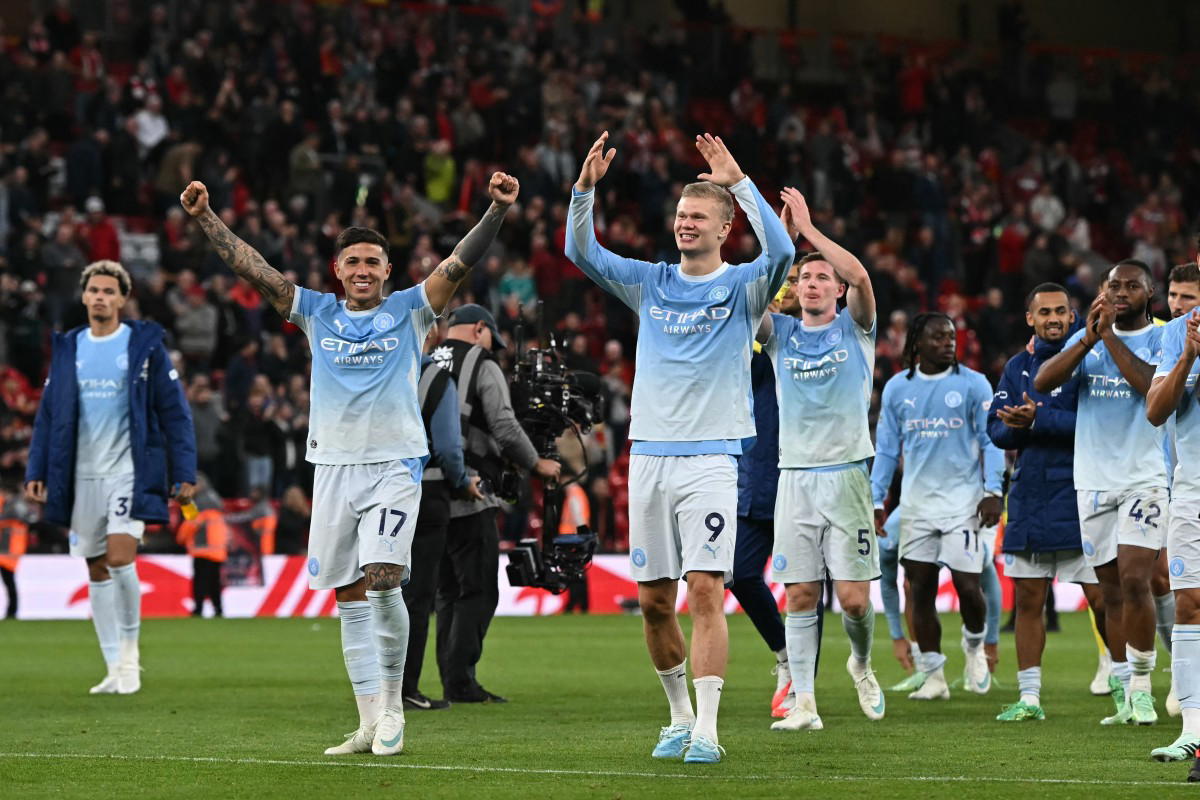
Erling Haaland said Manchester City’s 3-0 win at 10-man Liverpool showed they will “stick together” after the club was found guilty of breaching Premier League financial rules. Haaland put City ahead at Anfield on Sunday before Jeremy Doku and Rayan Cherki netted to silence Anfield after Liverpool fans barraged them with taunts about the guilty verdict. Enzo Maresca’s side showed no signs of being fazed by the abuse in their first match since the club discovered an independent commission had found them guilty of breaking over 100 financial regulations. City, who are appealing against the decision, could face a massive points deduction that would likely lead to relegation or even be stripped of their titles. But for now Norway striker Haaland insisted their defiant performance at old rivals Liverpool proved they are still committed to the City cause. “Every single person that is part of Man City, and every fan, this is a lovely moment that will stay with us for a long time,” he said. “It was hard, but we showed amazing character from back to front. So proud of everyone. It’s always tough to come here. “Important to stay strong mentally, stick together and do what you can do something about and the thing we can do something about is to play good football and fight together. That’s the only thing we can do.” City were helped by Liverpool midfielder Ryan Gravenberch’s red card for two bookings just prior to Haaland’s opener. They ran riot after that to move three points clear at the top of the Premier League. Whether they are able to maintain a title challenge with a potential punishment looming remains to be seen. Haaland said City’s players can only concentrate on their performances while the club’s Abu Dhabi-based owners deal with the legal ramifications of the verdict. “You want to win games, it’s as simple as that. Perform well, play good football and win games. This was a mental battle,” he said. “Proud that we managed to stick together, we are mentally strong. Plenty of games coming up so time to recover and go again.” City midfielder Elliot Anderson delivered a composed display in his first taste of the rivalry with Liverpool after his close-season move from Nottingham Forest. The England international echoed Haaland’s assessment of his side’s spirit, saying: “Togetherness, fight, a tough place to come and we stuck together and fought for each other. We’ve showed courage. “The atmosphere was more than normal, arriving into Anfield and the first 10 minutes of the game. “We did well to quieten the crowd. Struggled first half but second we were better and then the goals came.”

Oct 12, 2026 • 39
Advertisement
The Wait is Over: Premier League Returns with a Bang After International Break Sports

The Wait is Over: Premier League Returns with a Bang After International Break

The international break has concluded, and the Premier League returns this weekend with a highly anticipated slate of fixtures. After a two-week hiatus filled with national team duties, domestic football resumes today with a schedule that promises immediate drama, tactical battles, and significant implications for the league standings early in the 2026-27 campaign. The Early Kick-Off: Arsenal vs. Leeds United The weekend’s action begins at the Emirates Stadium, where Arsenal hosts Leeds United. Mikel Arteta’s side will be eager to establish dominance and set the tone for the weekend following a mixed bag of results prior to the break. The Gunners have been formidable at home, and a victory in the 12:30 BST kick-off would send a strong message to their title rivals. Leeds United, however, will not be straightforward opponents. Known for their high-energy pressing and quick transitions, Leeds will look to exploit any signs of lethargy from Arsenal players returning from extended travel. This fixture has historically produced high-scoring affairs, making it an ideal curtain-raiser for the weekend. The 15:00 Block: Battles Across the Table The traditional 15:00 BST slot features four crucial matches that span the length of the Premier League table. At Stamford Bridge, Chelsea welcomes Bournemouth. Chelsea will be looking to capitalize on home advantage to build momentum, while Bournemouth faces a stern test of their defensive organization against a technically gifted London side. Meanwhile, Aston Villa takes on Brentford at Villa Park in what promises to be a tightly contested tactical duel. Both sides share ambitions of securing European football, and early-season points in these direct encounters often prove vital in May. Newly promoted Ipswich Town will host Fulham at Portman Road. For Ipswich, making their home stadium a fortress is critical to their survival hopes, and they will view this match as a prime opportunity to secure three points. In the northeast, Sunderland faces Brighton & Hove Albion at the Stadium of Light. Brighton’s fluid, possession-based system will clash with Sunderland’s organized defensive setup, creating a fascinating contrast in playing styles. The Evening Showdown: Manchester United vs. Tottenham Hotspur The marquee matchup of the day takes place at 17:30 BST as Manchester United face Tottenham Hotspur. Matches between these two heavyweights are rarely short on entertainment, and this evening clash is expected to be no different. Both clubs are navigating high expectations and intense scrutiny, making a positive result essential for their respective managers. Manchester United will rely on the electric atmosphere of their home support to push them forward, aiming to control the midfield and unleash their attacking pace. Tottenham, conversely, will bring their aggressive, front-foot approach, looking to dictate the tempo and test United’s defensive resolve from the opening whistle. The tactical battle in the center of the pitch, combined with the sheer individual quality on both sides, makes this an unmissable conclusion to Saturday’s Premier League return. With vital points on the line and squads reassembled from across the globe, the Premier League is officially back.

Oct 10, 2026 • 48
‘Tinubu Will Do Anything To Win This Election’, Nigerians React To FG’s Fresh Moves Politics

‘Tinubu Will Do Anything To Win This Election’, Nigerians React To FG’s Fresh Moves

Nigerians have questioned President Bola Tinubu’s motives following the Federal Government’s announcement of a 30-day petrol discount at Nigerian National Petroleum Company Limited (NNPCL) filling stations. Some described the move as an attempt to win public support ahead of the 2027 general election. The reactions followed Thursday’s announcement by the Minister of Finance and Coordinating Minister of the Economy, Taiwo Oyedele, that the government would offer discounted petrol for an initial 30 days, prioritising public transport operators. The measure comes more than three years after Tinubu announced the removal of petrol subsidy. It has triggered fresh questions about why the government is introducing temporary relief now, following prolonged complaints over rising fuel prices, transportation costs and the cost of living. Some Nigerians who reacted to the announcement on social media questioned whether the intervention was designed primarily to ease economic hardship or improve the electoral prospects of the ruling All Progressives Congress (APC). Political commentator, Ugo Egbujo, said that the latest move was part of an attempt by the president to improve his chances in the 2027 election. “Tinubu will do anything to win this election. He can temporarily return fuel subsidies and unfriend Chagoury and seize Wike’s Rolls-Royce. After winning, he will return his old habits,” Egbujo wrote. Other Nigerians also questioned the timing and duration of the intervention. Haroun El-Yahya Hassan asked why the government had waited so long before introducing the measure. “Where were they 40 months ago? He must go forever, God’s willing,” he wrote. Similarly, Almajir Abdullahi invoked a Hausa expression to suggest that the intervention had come too late. “In Hausa we say, ‘Masa ta bayan biki,’ which literally means, no benefit to make a guest’s food after the ceremony,” he said. The comments reflects a broader concern among critics that the administration, having defended the removal of petrol subsidy as a necessary economic reform, was now introducing a temporary concession as the next general election approaches. Under the new arrangement, Oyedele said the government would offer a discount on petrol sold at NNPCL stations for 30 days, with priority given to public transport operators. “We are offering a discount on petrol dispensed by NNPC Limited for the next 30 days in the first instance, with priority for public transporters nationwide. So, it’s not a subsidy; the government is just saying we sell to you at cost,” he said. The minister also disclosed that the government was negotiating a ceiling of N1,350 per litre on petrol’s ex-gantry or landing cost, subject to monthly reviews, to moderate the impact of fluctuations in global crude oil prices and exchange rates on pump prices. However, the announcement has not convinced some Nigerians that the intervention will provide lasting relief. Abdulrahman Abba Saleh said he preferred a government that demonstrated commitment to a permanent solution rather than a temporary intervention. “We prefer the person who has demonstrated readiness for a permanent solution (subsidy reversal) than one-month solution,” he wrote. Ovie Ezimeruwe also questioned the sustainability of the arrangement. He asked: “What will they do for that one month? Why can’t they do it after then? After one month, what next?” For his part, Isiya Al’majir Keta questioned the change in the government’s position on fuel prices. According to him, “They said petrol can never reduce the price, what has changed the story?” Daily Trust reports that the latest development comes against the backdrop of Tinubu’s May 29, 2023, inauguration, when he declared that “fuel subsidy is gone”. The decision led to sharp increases in petrol prices and transportation fares. The administration has consistently defended the policy as necessary to reduce the financial burden of subsidising petrol and redirect public resources towards development. However, the immediate consequences have remained a major source of public dissatisfaction, with higher transport and production costs feeding into the prices of food and other essential goods. The fresh intervention has reopened the debate over whether the government is responding to the economic realities confronting Nigerians or seeking to address mounting public discontent ahead of the 2027 polls. Usman Auwal Hassan suggested that the announcement would not have been made without the approaching election. “If not because of the election, they shouldn’t say that,” he wrote. Michael Otues argued that even a substantial reduction in petrol prices would not necessarily change his political preference. “If you guys like, make the price of fuel N100, it is not going to change our mind to vote for APC. Nigerians are wise now,” he said. Abdullazeez Abdullahi also called for the government to focus on winning public acceptance rather than resorting to electoral manipulation. “All options considered… No way to rigging; let’s do what is acceptable by the masses. It’s too late,” he wrote.

Oct 9, 2026 • 16
‘Election Package’, Atiku Taunts Tinubu Over 30-Day Fuel Discount Local News

‘Election Package’, Atiku Taunts Tinubu Over 30-Day Fuel Discount

Former Vice-President Atiku Abubakar has condemned the Federal Government’s proposed 30-day fuel discount at NNPC stations, describing it as a desperate, temporary gesture that cannot repair the damage caused by the crushing cost of fuel. In a statement issued by Phrank Shaibu, Director of Strategic Communication of the ADC Presidential Campaign Council, Atiku said the Tinubu administration’s attempt to dangle a fuel subsidy as bait for Nigerians was reckless, disgraceful and scandalous. He said the same government had watched Nigerians endure excruciating hardship without offering meaningful relief. “Now, as the election draws closer, President Tinubu is dangling a temporary discount at the very epicentre of the cost-of-living crisis that has tormented households and businesses.” “Atiku totally rejects this calendar-scheduled, election-laced subsidy package. Nigerians are not fools to be offered a month of discounted fuel after years of punishing prices and then expected to forget the hardship when the discount expires. This is shameless and heartless,” he said. Atiku said the proposed 30-day discount was not an economic plan but a political bandage on a wound the government had helped create. “What happens on Day 31? Nigerians wake up to the same brutal prices, the same punishing transport fares and the same rising cost of food. The government cannot manufacture relief for one month and expect Nigerians to applaud while the hardship remains,” he said. He noted that the offer is limited to NNPC stations, while the government has yet to state how much motorists will save per litre or guarantee that any savings for transport operators will be passed on to passengers through lower fares. The former Vice President said the administration’s sudden reversal on this sensitive social welfare issue was itself an admission of guilt over the hardship Nigerians have endured. It also exposed the weakness of the government’s repeated claims that meaningful relief was impossible. “This volte-face proves that the production-support proposal I have advanced is workable, achievable and not complicated. The Tinubu government and its spin doctors have tried to make it sound impossible, yet they are now reaching for a temporary subsidy-style intervention because the pain has become impossible to ignore,” Atiku said. He reiterated his proposal for capped and budgeted production support tied to fuel refined in Nigeria, with safeguards to ensure that the benefit reaches consumers and supports local refining. “Nigerians need lasting relief, not a countdown to the return of hardship. Tinubu’s government cannot spend years telling Nigerians to endure, then offer 30 days of relief and call it a solution,” he said. Atiku restated his commitment to making life affordable again. “Tinubu made life expensive. I will make life affordable again.”

Oct 9, 2026 • 14
Court Dismisses El-Rufai’s Suit Against DSS, EFCC, ICPC, Others Politics

Court Dismisses El-Rufai’s Suit Against DSS, EFCC, ICPC, Others

A Federal High Court sitting in Abuja, on Thursday dismissed the suit filed by a former governor of Kaduna State, Nasir El-Rufai, to seek an order restraining the Department of State Services (DSS), Independent Corrupt Practices and Other Related Offences Commission (ICPC) and others from freezing his bank accounts and seizing his assets. The court, while dismissing the suit, held that the suit was speculative in nature and lacked merit, adding that the case did not disclose any reasonable cause of action against the EFCC, DSS and AGF, and subsequently struck out their names from the suit. Daily Trust reports that the suit, dated February 23, 2026 and filed on February 24, 2026 by Oluwole Iyamu, a Senior Advocate of Nigeria, urged the court for an order of interim injunction directing the respondents to maintain the status quo ante. Other respondents in the suit included the Economic and Financial Crimes Commission (EFCC), Department of State Services (DSS) and Attorney-General of the Federation (AGF), who were joined as 2nd to 4th respondents respectively. In the suit, El-Rufai argued that the order was necessary to prevent a fait accompli as recognised in previous cases, praying for a declaration that his severance pay, received upon the completion of his tenure as governor of Kaduna State between 2015 and 2023, cannot reasonably be suspected to be, proceeds of any unlawful activity. The former governor sought a declaration that the properties purchased by him from his said severance pay were lawfully acquired and owned by him. He listed the banks to include Zenith Bank Plc, Naira Account Number: 1007158671; Zenith Bank Pic, Domiciliary Account Number: 507 1511327; Guaranty Trust Bank (GTB) Plc (GTB), Account Number: 0023824978; Access Bank, Dollar Account Number: 1396386493 and Access Bank, Naira Account Number: 1396382103. El-Rufai also sought a declaration that any attempt by the respondents to apply for, obtain or execute any interim or final forfeiture order, freezing order, without first establishing a reasonable suspicion supported by credible evidence as required by relevant law would amount to a breach of his rights. Citing Section 17(1) of the Advance Fee Fraud and Other Related Offences Act, 2006 and the Supreme Court decision in Melrose General Services Ltd v. EFCC (2024) SC/1519/2019, El-Rufai prayed the court to declare that, as a citizen of Nigeria, is entitled to the presumption of innocence and the protection of his fundamental rights. He said that any action by the respondents that seeks to circumvent these rights by way of ex-parte applications that conceal material facts would amount to a breach of Section 36(5) of the constitution and a violation of the principles of fair hearing. The ex-governor, therefore, sought an order of perpetual injunction restraining the respondents from taking any step whatsoever to freeze, attach, seize, forfeit, or otherwise interfere with his said property and bank accounts. He sought an order awarding the sum of N1 billion “as general, exemplary, and aggravated damages against the respondents jointly and severally for: “The anticipated violation of the applicant’s fundamental rights; The psychological trauma, distress, anxiety, and reputational harm caused by the threat of unlawful forfeiture proceedings. “The need to deter the respondents and other agencies from engaging in similar overreach, abuse of power, and disregard for constitutional safeguards.” He equally sought an order awarding the sum of N100 million as costs of the action against the respondents, including legal fees and associated expenses. The ICPC, in its preliminary objection filed by Abdul Mohammed, SAN, prayed the court to dismiss the suit in its entirety for being “incompetent and a gross abuse of court process”. The ICPC submitted that El-Rufai’s arrest, the search of his residence and the anticipated asset tracing and freezing all stemmed from a singular, continuous and ongoing criminal investigation by the commission. It argued that rather than consolidating his grievances into a single, comprehensive action, the ex-governor deliberately engaged in forum shopping and the fragmentation of his claims by instituting three parallel suits across two different court hierarchies within a span of just 12 days. It said that besides the instant suit, the applicant filed suit number: FHC/ABJ/CS/345/2026 on Feb. 20 at FHC, challenging the search warrant and the enforcement of fundamental human rights. The commission said El-Rufai also filed suit number: FCT/HC/CV/950/2026 on March 3 at the FCT High Court, challenging the remand order and the enforcement of fundamental human rights. It argued that the deliberate proliferation of overlapping suits seeking identical monetary and injunctive reliefs against the same primary law enforcement agency constituted “a textbook definition of abuse of court process. It also argued that the suit was designed to irritate the commission, overreach the judicial system and create the perilous risk of conflicting judgments from coordinate courts.” The DSS, in its preliminary objection filed by Ayodeji Adedipe, a Senior Advocate of Nigeria, urged the court to strike out the suit for being incompetent. It also prayed the court to strike out its name from the suit for failure to disclose any reasonable cause of action against the service, among others. The AGF, also in his counter affidavit argued in court by Maimuna Lami-Shiru, Director of Civil Litigation and Public Law, submitted that the 4th respondent is only a necessary party in suits that directly involved the Federal Government of Nigeria. She argued that the depositions in El-Rufai’s affidavit were speculative. The lawyer argued that an interim forfeiture is not a final forfeiture order and it was only necessary to enable the ICPC carry out its investigations. She submitted that an application for an interim forfeiture order did not in any way breach El-Rufai’s rights. The director also argued that the ICPC, EFCC and DSS are empowered to make an application for forfeiture to a court of competent jurisdiction, in the course of their investigations. The lawyer, who urged the court to dismiss the suit, said the ex-governor had similar cases in FCT High Court and FHC, where he sued the 1st, 2nd and 4th respondents. But delivering his judgement after all the arguments, Justice Joyce Abdulmalik, dismissed the suit for being an abuse of court process because the former governor had filed a similar suit in the FCT High Court. Justice Abdulmalik agreed with the arguments of the ICPC, EFCC, DSS and AGF that a court of law cannot be used by any citizen to prevent law enforcement agencies from performing their statutory duties.

Oct 9, 2026 • 16
Atiku Accuses Tinubu of Abandoning Farmers, Killing Agricultural Exports Politics

Atiku Accuses Tinubu of Abandoning Farmers, Killing Agricultural Exports

Former Vice President and African Democratic Congress (ADC) presidential candidate, Atiku Abubakar, has accused President Bola Tinubu’s administration of undermining Nigeria’s agricultural sector, blaming the government for declining export earnings, insecurity and rising production costs. Atiku said the administration had failed to deliver on its promise of building a productive economy, arguing that Nigeria continued to export raw agricultural commodities while losing the jobs and revenue that could be generated through domestic processing. He made the remarks in a statement issued on Wednesday by Phrank Shaibu, Director of Strategic Communication of the ADC Presidential Campaign Council. Atiku cited recent trade figures showing that Nigeria’s agricultural trade position moved from a N740.27 billion surplus in the first half of 2025 to a N56.13 billion deficit in the corresponding period of 2026. He described the N796.40 billion reversal as evidence of worsening conditions in the agricultural sector, noting that agricultural exports declined by 33.3 per cent, despite a fall in imports. “The excuse that Nigerians simply imported too much will not stand. Tinubu’s government must answer for the collapse in what Nigeria sold to the world. “The country is losing export earnings, and the President owes farmers, workers and businesses more than another speech about prosperity,” Atiku said. He questioned what the administration had done to improve security for farmers, reduce the cost of transporting agricultural produce, support processing companies and make Nigerian products more competitive in international markets. Atiku also criticised Nigeria’s continued dependence on the export of unprocessed agricultural commodities, citing cashew nuts in shell and cocoa beans among the country’s major agricultural exports. According to him, Nigeria loses significant economic value when raw commodities are exported for processing elsewhere. “We grow the crop. Someone else does more of the processing, builds a business around it and earns the larger return. Then Tinubu speaks of jobs while Nigerian factories struggle to compete,” he said. The former vice president said his proposed production subsidy for petroleum products refined in Nigeria was designed to keep more value within the country. He said the proposed scheme would cover qualifying products from Nigerian refineries, including modular refineries, while imported products would be excluded. He added that the subsidy would be capped, budgeted and independently audited. Atiku also described the Tinubu administration’s Compressed Natural Gas (CNG) initiative as an ineffective relief measure, arguing that the cost of vehicle conversion remained unaffordable for many Nigerians. He said limited access to conversion kits and the unavailability of some buses presented as palliatives had further weakened the impact of the programme. “Local refining is about more than the price at the petrol pump. Aviation fuel affects fares. LPG affects the cost of cooking. Petroleum products and feedstocks affect industries and the people they employ,” Atiku said. He promised that, if elected president, his administration would prioritise domestic production, processing and refining while supporting farmers and manufacturers. “My administration will begin restoring a transparent production subsidy from Day One. We will back farmers and processors with the same determination. “Grow it here. Process it here. Refine it here. Create the jobs here. Make life affordable here,” he said. Atiku accused the Tinubu administration of leaving Nigeria dependent on the export of raw commodities and crude oil while citizens continue to pay high prices for finished products. “A government that cannot turn our resources into affordable products and decent jobs has failed the people it was elected to serve,” he said.

Oct 8, 2026 • 14
The Broken Promise of 1945: How the Global South Rose at the UN and Demanded a New World Politics

The Broken Promise of 1945: How the Global South Rose at the UN and Demanded a New World

Part 1 By Hassan Husaini mni When the United Nations was born on October 24, 1945, the world was still burying its dead. Seventy million people had perished in a war that had reduced entire continents to rubble, and the men who gathered in San Francisco to sign the Charter understood that they were engaged in an act of desperate hope. The Preamble they produced remains one of the most ambitious sentences ever written by human hands: a pledge to “save succeeding generations from the scourge of war,” to reaffirm “faith in fundamental human rights, in the dignity and worth of the human person,” and to uphold “the equal rights of men and women and of nations large and small.” It was a covenant between the powerful and the powerless, a promise that the strong would be bound by law and the weak would be protected by it. That promise has not been kept, and the 81st General Assembly was where the bill finally came due. To be fair, the UN’s achievements are real. It helped prevent a third world war, provided a forum for dialogue during the Cold War, midwifed decolonization, and gave the world the Universal Declaration of Human Rights. The World Health Organization eradicated smallpox; UNICEF saved millions of children; peacekeepers stood between warring parties in dozens of conflicts; and the Sustainable Development Goals gave the world a shared vision for ending poverty. These are not small things. But from the beginning, the architecture was poisoned at the root. The Security Council was built to serve the victors of 1945. Five nations—the United States, the United Kingdom, France, Russia and China—were handed the veto, a device that allows any one of them to block any resolution no matter how overwhelming the international consensus. This was never a tool of justice. It was a tool of protection, a means by which the powerful could exempt themselves from the very laws they demanded others obey. The veto is not a flaw in the design of the United Nations; it is the design. The consequences have been catastrophic. During the Cold War the Council was paralysed while the Soviet Union crushed Hungary, while America burned Vietnam, while Moscow occupied Afghanistan. In 1994, as nearly a million Tutsi and moderate Hutu were slaughtered in Rwanda over a hundred days, the Council debated the meaning of the word “genocide” and refused to act, with Washington actively obstructing a robust peacekeeping force. In 2003, the United States and the United Kingdom launched a war of aggression against Iraq without Council authorisation; Secretary-General Kofi Annan called it “illegal,” and his words changed nothing. In Syria, Russia has vetoed resolution after resolution while the Assad regime gassed its own people. Over and over, the veto has shielded the guilty and abandoned the innocent, and over and over, Africa and the Global South have paid the price. It was into that graveyard of broken promises that the 81st General Assembly spoke with astonishing clarity. President Luiz Inácio Lula da Silva of Brazil warned that the United Nations was drifting towards “irrelevance,” denounced the paralysis of the Security Council as “unacceptable,” and declared plainly that “the world of 1945 is not the world of today.” He demanded a global financial architecture that puts people before profit, and he came not only with grievances but with a Brazilian initiative on climate change—proof that the South is bringing solutions, not just complaints. President William Ruto of Kenya sharpened the knife. Africa, he reminded the hall, is home to more than 1.4 billion people and is the only major region without permanent representation on the Security Council. It is a permanent item on the Council’s agenda—the Sahel, the Horn, the Great Lakes, always Africa—yet it is denied a permanent voice in the decisions that shape its own peace. “This is not just a matter of equity,” he said. “It is a matter of justice.” President Nana Akufo-Addo of Ghana reinforced the point, calling for a global order built on justice, equity and mutual respect, and reminding his peers that the struggle is fought on two fronts: the global and the domestic. Vice President Kashim Shettima of Nigeria carried Africa’s most populous nation into that debate, speaking for President Bola Ahmed Tinubu. Nigeria’s argument was that no single nation—however powerful—can solve climate change, terrorism or economic inequality alone, and that multilateralism must therefore be renewed. But Shettima was equally emphatic that cooperation must rest on equity, not on the perpetuation of an unjust order. He pressed Africa’s case for a permanent seat, insisting the continent’s voice must be heard where decisions about its future are made. Crucially, he did not stop at institutional reform. He spoke honestly about democracy and good governance as the foundations of development, acknowledging that building strong democratic institutions and ensuring elections reflect the genuine will of the people remains an unfinished struggle. He named terrorism as a scourge that has cost thousands of Nigerian lives and demanded global cooperation against it. He spoke of the debt burden crushing African economies—much of it incurred by corrupt leaders—and called for a financial system that works for all nations. And he spoke with a moral authority few could match: Nigeria has moved from military rule to democracy, has bled in peacekeeping missions across the world, and has led in ECOWAS and the African Union. But it was the Prime Minister of Niger, Ali Mahamane Lamine Zeine, who delivered the most defiant African address of the session. His message was uranium, sovereignty, France, Ukraine, the Alliance of Sahel States, and a declaration that Niger will never again surrender control of its resources. He declared: “For more than half a century, Niger’s uranium has lit the cities of Europe while our cities have remained in darkness. That injustice is now over.” He announced that Niger had recovered control of SOMAÏR in June 2025 and declared that the uranium currently produced and stockpiled belongs exclusively to Niger. “The current stock belongs to our country,” he said. “It does not belong to anyone, and we will sell it to all those who wish to buy.” After foreign operators left, equipment was sabotaged, but Niger invested approximately 30 billion CFA francs to restart production entirely with Nigerien workers and experts. “Not a single foreigner was involved in that,” he declared. Then came his accusation against France and Ukraine. He argued that the conflict in the Sahel is not merely terrorism but part of an attempt to regain control over African resources. “Niger’s uranium, Mali and Burkina Faso’s gold, lithium, gas, oil and so many other riches still make the former colonial powers salivate,” he said, describing terrorism in the region as “the cynical machinery of recolonization dressed in the trappings of extremism.” He then directly accused France, with Ukrainian complicity, of destabilizing the central Sahel. “The Sahel sees, the Sahel hears, the Sahel remembers, and the Sahel understands things very well,” he declared, before delivering a stark warning: “They are about to attack our military positions and our oil installations. But inshallah they will find what they deserve if they do so.” That was not diplomatic ambiguity. That was a direct warning from the UN podium. Niger described the Alliance of Sahel States as “a profound, lasting, irrepressible and irreversible change, Inshallah.” He said: “Our resources belong to our peoples. Our future will no longer be decided elsewhere.” He revealed that the AES now has a 5,000-person unified force, expandable to 15,000, its own investment and development bank, biometric passport, television channel, press agency, radio and confederation parliament. Importantly, he said their development bank “finances our projects and programs using our own resources.” This was striking because, unlike many of the African speeches delivered at this UNGA, Niger spent considerable time emphasizing domestic financing. The government, he said, is financing agriculture and basic social services through “voluntary contributions of Nigeriens themselves, in addition to revenues drawn from the exploitation of our mineral and oil resources.” He said oil and uranium revenues are being directed toward security, agriculture, electrification, water, sanitation, education and healthcare. “These are our results that we have achieved through our own means and resources,” he declared. The government claims its agricultural program has produced a major change: “For the first time in decades our country has not faced food shortages or had to call upon foreign assistance.” It now intends to halve grain imports by the end of 2027. Niger explicitly named its “true friends”: Togo, Türkiye, Morocco, the Russian Federation, and the People’s Republic of China. He separately gave particularly strong recognition to Algeria, calling it “a kindred and neighboring country,” and credited Algeria with substantial investment in Niger’s natural resources, support for its defense system, and cooperation in health, education, energy, water and agriculture. And, of course, Niger identified Mali and Burkina Faso not merely as friends but as its core partners in the Confederation of Sahel States. The geopolitical picture presented from the podium was remarkably clear: the AES family of Mali and Burkina Faso as core partners, Algeria as a strategic neighbor singled out for support, and Togo, Türkiye, Morocco, Russia and China as countries explicitly called “true friends.” On Palestine and Gaza, Niger expressed concern and called for protection of civilians and unrestricted humanitarian access, reaffirming support for a two-state solution. On Security Council reform, Niger reaffirmed the Ezulwini Consensus and said Africa’s exclusion from permanent membership must stop being “the subject of sterile debates repeated day after day.” And in perhaps the clearest summary, the Prime Minister declared: “Niger intends to fully exercise its sovereignty over its natural resources and will never again accept any restriction imposed from outside on its sovereign right to freely choose its partners.” He added: “That right is inalienable and it is non-negotiable.” Perhaps no sentence captured the tone better than this: “Our resources belong to our peoples. Our future will no longer be decided elsewhere.” Then came Prime Minister Mia Amor Mottley of Barbados, who delivered what many in that chamber will remember for the rest of their lives. Speaking without a single note, holding the assembly in absolute silence, she wove climate, debt and inequality into one seamless indictment of a rigged global system. She described small island states paying with their existence for the carbon emitted by industrialised powers, a financial architecture that suffocates those least able to pay, and an order that treats poor lives as expendable. “We are not asking for charity,” she said. “We are asking for justice.” It was a masterclass in leadership, and it proved that true power lies not in armies but in ideas articulated with courage. President Recep Tayyip Erdoğan of Turkey and President Cyril Ramaphosa of South Africa completed the chorus, the former demanding a ceasefire and a Palestinian state, the latter speaking from a nation that survived apartheid and had just taken Israel to the International Court of Justice. Ramaphosa bound Palestine to Western Sahara, to Cuba, to Venezuela, insisting no nation is above the law. Together, these voices were not begging. They were diagnosing. And their diagnosis was unanimous: what stands in New York is not a system of justice. It is a system of power. Until that changes, its legitimacy will continue to bleed away.    

Oct 8, 2026 • 34
Advertisement